Biography
Eyal Gever
Creating Art From Energy
Born 1970, Haifa. Lives and works in Tel Aviv, Israel.
Follow Eyal on Instagram & LinkedIn
Gallery representation:
Tel Aviv: Alon Segev Gallery
London: The Disruptive Gallery
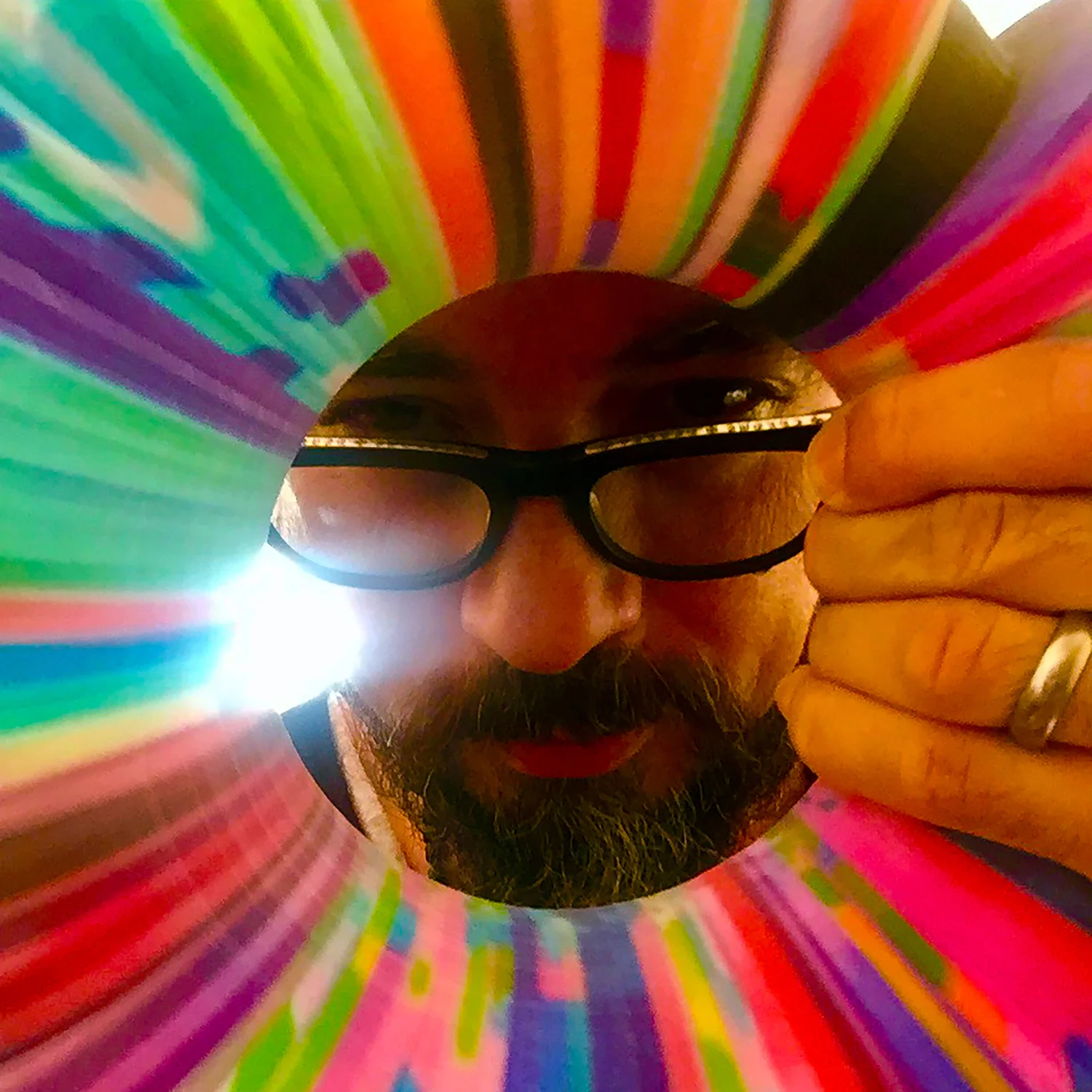
Biography
Eyal Gever is a contemporary artist born in 1970 in Haifa, Israel, living and working in Tel Aviv. For over three decades, his practice has operated at the intersection of art, technology, and physical systems, using advanced simulation, computational design, and fabrication to make the unseen visible: to transform invisible forces of energy, motion, and emotion into sculptural form, light-based installation, and immersive environments.
Uncontrollable power, unpredictability, and cataclysmic extremes are the sources of his work. Through custom-built physics simulations, Gever captures tension, turbulence, release, and transformation at the instant of their highest intensity, translating sublime or catastrophic moments (tsunamis, collisions, combustion, the waveform of human laughter) into three-dimensional printed sculpture or monumental projection installation. Beauty, he insists, can come from the strangest of places in the most horrific events. His art addresses these collisions of opposites: destruction and beauty, fear and hope, seduction and betrayal.
His practice engages questions of human perception, collective feeling, our impact on nature, and the relationship between technological systems and emotional life. Working at the frontier of art, science, and technology, Gever uses software, mathematics, physics, and new fabrication techniques as his palette to create art that explores what it means to be human in the extreme present, which he considers the most urgent conversation of our time.
This trajectory finds its most direct expression in FORCES: The Physics of Feeling, a major new body of work and exhibition at The Disruptive Gallery in London, where emotion is approached not as illustration but as a physical event, shaped through pressure, gravity, friction, containment, and release.
Selected projects include Cosmic Portals, developed in conjunction with the Beresheet 2 (Genesis 2) lunar mission, in which live deep-space data is transformed into generative sculptural experience; hy·per·re·ac·tive, an audiovisual technology platform more than two years in development, in which every beat, note, and frequency is sculpted in real time into fluid, responsive, evolving three-dimensional art, making sound not just heard but seen, felt, and lived; HyperScape, a permanent immersive sound-responsive installation commissioned for Club Chinois, Ibiza, one of the island's most prestigious venues, using projection mapping to transform the club dancefloor each night with visuals that react in real time to live music performed by the world's leading DJs; and Plastivore, an impact art project dedicated to the fight against plastic pollution, repurposing plastic waste collected from oceans and nature into art and into 3D-printed building blocks for communities in need, mobilising art as a tool for social change.
From there, Gever extended his research into a deeper challenge: using contactless emotional AI, reading facial blood flow, heart rate, and micro-expressions in real time via Transdermal Optical Imaging, to create art that senses and responds to how the viewer feels. That research became the foundation of the Empathic Art manifesto and a new artistic movement he calls Empathicism. In the extreme present, where machines and AI are reshaping what it means to be human, Gever's central conviction is this: art must feel. Empathic Art senses and responds to human emotion in real time, fusing neuroscience, emotional AI, and the artist's creative vision. The artwork listens, reflects, and adapts, forming a living feedback loop between art and viewer.
Earlier works include Uncanny State: Notion of Acceptance, which translated the choreography of Sharon Eyal and music by Rosey Chan into computational digital sculpture; Water Dancer and Fire Dancer, public commissions during Eurovision 2019 in Tel Aviv; #Laugh (2017), the first artwork ever created in space, produced aboard the International Space Station in collaboration with NASA and Made In Space; and CLEANSING, a 400-meter façade projection commissioned by ZKM | Center for Art and Media for Karlsruhe Palace. His work has been presented alongside J.M.W. Turner and Gerhard Richter in Turner and the Tradition of the Sublime, and at the Lichtsicht 5 Projection Biennale, curated by Peter Weibel, alongside William Kentridge, Robert Wilson, and Random International.
His projects have been exhibited and commissioned by institutions including ZKM | Center for Art and Media and the Rijksmuseum, and received coverage in Wired, Financial Times, CNN, Ars Electronica, IEEE Potentials, and Art in Orbit: Art Objects and Spaceflight (Bloomsbury, 2024). He is the recipient of the Technarte Bilbao International Art and Technology Award (Museo Guggenheim Bilbao, 2017), a finalist in the World Technology Awards (2018), and a laureate of Beyond Bauhaus (The Bauhaus Association, 2019).
Before dedicating himself fully to art, Gever founded and led several technology ventures, including Zapa Digital Arts (later Gizmoz), one of the world's earliest virtual worlds and real-time 3D avatar platforms, and served as President of DAZ 3D. That technological foundation remains inseparable from his artistic practice and continues to shape the systems he builds and the questions he asks about human perception, emotion, and the future relationship between art and technology.
Education
Bezalel Academy of Arts and Design, Jerusalem, Israel
Fine Art
Exhibitions and Major Commissions
2026
FORCES: The Physics of Feeling, The Disruptive Gallery, London, United Kingdom
7 May 2026
2025
Empathic Art Manifesto, founding publication of the Empathic Art movement
2024
Cosmic Portals, in conjunction with the Beresheet 2 (Genesis 2) lunar mission, live deep-space data transformed into generative sculptural experience, Israel
2022 (ongoing)
HyperScape, immersive sound and vision installation, Club Chinois, Ibiza, Spain
2021–24
hy·per·re·ac·tive, real-time audiovisual experiential artwork, immersive installation, international venues
2020 (ongoing)
Plastivore, an impact art project addressing plastic pollution, 3D-printed sculptures from ocean-collected recycled plastic waste filament, international venues
2019
Uncanny State: Notion of Acceptance (solo), Alon Segev Gallery, 7 HaManoa Street, Tel Aviv, Israel
5 September – 18 October 2019
Works translating choreography by Sharon Eyal and music by Rosey Chan into computational digital sculpture.
Water Dancer and Fire Dancer, Eurovision 2019 public commission, Tel Aviv–Jaffa Municipality, Tel Aviv, Israel
Seen by tens of thousands of visitors during Eurovision week.
2017
CLEANSING, 400-meter façade projection mapping installation, Karlsruhe Palace, commission by ZKM | Center for Art and Media, Karlsruhe, Germany
Seen by hundreds of thousands of visitors annually.
2015–2016
Gevaar & Schoonheid: Turner & the Tradition of the Sublime, Rijksmuseum Twenthe, Enschede & Museum de Fundatie, Zwolle, Netherlands
6 September 2015 – 3 January 2016
Exhibited alongside J.M.W. Turner and Gerhard Richter. (Nederlands Dagblad)
2015
Water Dancer, light projection on water wall, Lichtsicht 5 Projection Biennale, Bad Rothenfelde, Germany, 2015–16. A 3D simulation of a water dancer projected onto an intermittent fountain, creating a haze of water droplets in which the dancer's body continuously disperses and reforms. Presented alongside William Kentridge, Robert Wilson, Ryoji Ikeda, and Random International, curated by Peter Weibel (ZKM). (Artlight Magazine)
2014–2017
#Laugh, first artwork ever created in space, fabricated aboard the International Space Station in collaboration with NASA and Made In Space, International Space Station / Earth orbit
2012
Sublime Moments (solo), Alon Segev Gallery, Tel Aviv, Israel
30 May – 6 July 2012
Ongoing series, international exhibition and acquisition
Public Collections
Works held in private and public collections internationally. Full collection list available upon request.
Awards and Recognition
2019
Jury Member, Beyond Bauhaus: Prototyping the Future, international competition organized by the German Bauhaus Association on the occasion of the Bauhaus centenary, Germany
2018
Finalist, Art Category, World Technology Awards (The World Technology Network)
2017
First Prize, Technarte Bilbao International Art and Technology Conference, Museo Guggenheim Bilbao, Bilbao, Spain
Technology Patents
Gever holds eight registered patents for innovations spanning 3D computer graphics animation technologies, computer vision, and data transmission and propagation of rich media over networks. These include foundational work in programmable computer-generated objects and viral media distribution, among them US Patent 6,329,994, "Programmable Computer Graphic Objects", as well as patents in 3D animation engines, interactive object modeling, and media propagation systems that underpinned the technologies adopted by global technology firms.
View all patents on Google Patents
Press and Publications
Books and Catalogues
Brownie, Barbara. Art in Orbit: Art Objects and Spaceflight. Bloomsbury Academic, London, 2024.
Weibel, Peter. "Water Dancer." Lichtsicht 5 Biennale Exhibition Catalogue, Bad Rothenfelde, 2015.
Van Lieverloo, Karin. "Gevaar en Schoonheid (Turner en de traditie van het sublieme)." Exhibition catalogue, Rijksmuseum Twenthe, Enschede, 2016.
Van Lieverloo, Karin. "Fucking Nature (pg 95): Turner en de traditie van het sublieme." August 2015. [English translation]
Gever, Eyal. The Empathic Art Manifesto. 2025.
Gever, Eyal. The Conceptual Groundwork of Empathic Art. 2025.
Academic Publications
"The Interrelationship and Correlation of Technology and Art." IEEE Potentials, vol. 35, no. 1, 2015.
Ferrier, Michael. "De la Catastrophe considérée comme un des Beaux-Arts." Communications, no. 96, 2015.
Selected Media
"We Talked to the Artist Behind Space's First Native Sculpture." Vice Creators, December 2016.
"Turn Your Giggle into 3D-Printed Art." Wired, December 2016.
"Laughter to be 3D Printed and Launched into Space." CNN, December 2016.
"Software is eating the world, including art, too?" The Economist, December 2016.
"3D-Printed 'Laugh' Is 1st Major Artwork to Be Made in Space." Space.com, February 2017.
"Eyal Gever's 3D-Printed 'Laugh-Star' Becomes First Artwork Created in Space." Designboom, February 2017.
"Artwork of the Month: #Laugh." Ars Electronica, 2017.
"A Space Oddity that Sheds Light on Start-Ups and Artists." Financial Times, October 2015.
"Technology and Art: Engineering the Future." BBC, October 2012.
"Computer Coder Turns Disaster into Art." BBC, January 2012.
"Real vs Virtual." BBC World Service, October 2012.
"After 9/11, High-Tech Whiz Kid Turns Disasters into Art." Haaretz, June 2012.
"A Crash Course in the Beauty of Collisions." VICE Creators Project, July 2012.
"Eyal Gever's Distorted and Sublime Sculptures." VICE Creators Project, November 2011.
"How Tel Aviv Artist Eyal Gever Catches Catastrophes in 3D." Wired, October 2011.
"Eyal Gever, Artist, Simulates Incredible 3D Catastrophes Frozen in Time." Huffington Post, 2011.
"La sublime catástrofe." El Pais, September 2011.
"Minister of Design." Jerusalem Post, March 2012.
"Israeli Artist Eyal Gever Collaborates with NASA on First Space Art." Jerusalem Post, February 2016.
"לוכד הרגשות." Calcalist (Hebrew).
Prior Technology Career
Before devoting himself to art full-time in 2010, Gever founded and led several pioneering technology companies over nearly two decades.
Zapa Digital Arts (later Gizmoz), Tel Aviv, Founded while Gever was still a student at Bezalel, Zapa became a pioneer in virtual worlds, avatars, and patented real-time animation technology. Its technologies were adopted by global firms including Apple, IBM, News Corp, and Brøderbund, and integrated into Microsoft Windows 98's original Plus! pack (Newsweek, ZDNet). Zapa and Gever were profiled on the cover of Red Herring magazine (also referenced here) as a landmark innovator. In 1997, John Sculley (former CEO of Apple and Pepsi) joined as chairman and investor, calling the company "one of those rare inflection points when a new platform is born" (New York Times). Zapa evolved into Gizmoz, focusing on embeddable widgets and online digital avatars.
DAZ 3D, Utah, USA, Gever served as President following the Gizmoz–DAZ 3D merger; the leading publisher of personalized 3D digital characters and software for creative professionals and game developers.
Zapa Digital Arts, and later Gizmoz, attracted some of the brightest creative and technical minds of the era. Its culture, grounded in multidisciplinary innovation, is widely recognized as a wellspring for Israeli tech leadership and is frequently cited as a key catalyst in the rise of the Startup Nation (Haaretz, The Guardian, Newsweek). Among its most noted legacies: the core team of developers who went on to create ICQ met while working at Zapa and used it as their very first beta-testing site.
CV current as of 2026. Full exhibition history, press archive, and video documentation available at eyalgever.com.